
Lecture series
19/03/2026
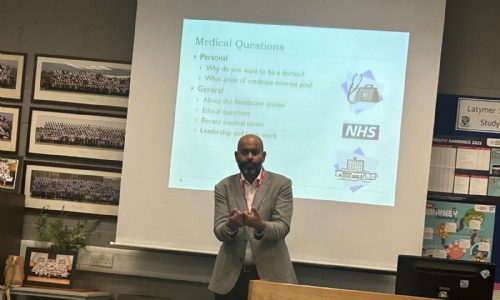
Applying to medical schools
On Thursday 26th February, Dr Rishi Chopra, class of 1996, came to deliver a talk to Year 12 students on how to get into medicine, covering UCAS applications, skills you should aim to demonstrate and what you should know about studying medicine.
Working as a GP partner, teacher and practitioner, Dr Chopra has a wealth of experience to share. Leaving Latymer in 1996, he took a gap year, where he “mopped the blood and guts” after surgeries at Whittington Hospital for three months and also spent some time in Chase Farm’s HR department “filing documents and making some coffee and tea” for doctors. From there, he headed to Queen Mary’s medical school, and trained to become a GP, his dream job, praising the care for "patients that are pre-cradal to post-grave” and the variety in his work.
Dr Chopra began by stating Year 12 students should start getting reading now with their UCAS applications, and to choose four medical schools wisely, coordinating with admissions officers in case of abnormal circumstances affecting your application. He provided tips for writing a compelling personal statement, asking students to aim to demonstrate that:
- you know what medicine actually entails (including its hardships).
- you possess an aptitude and passion for medicine.
- you know how to balance social and leisure time, often done by keeping consistent extracurriculars outside of academics.
- you can communicate with people of all ages.
Meanwhile to prepare for interviews, he recommended contacting other doctors, reading books, taking part in courses and keeping up with global medical affairs.
Dr Chopra also provided valuable information about medical schools. He touched on the decreasing applicants to prestigious medical schools like Oxbridge, and the increasing proportion of successful and female applicants. Going to medical school doesn’t seal a career as a doctor as it offers 2-3 degrees, the third of which being a general scientific degree, allowing potential career options such as science, military medicine or even medical journalism. He explored the charitable tendencies of medical students, the large student loans accumulated, the resilience of junior doctors, having worked 104 hours himself in his first week, and a potential elective year, allowing students to work in medicine wherever they like around the world.
Dr Chopra concluded that while there may be a lot going on right now and that he doesn’t know what the future of the NHS is, medicine remains “a highly respected career” and, in his opinion, “there is no higher career choice for man. If you want to do medicine, do it!”
After having listened to the talk, Leslie and Arianne, Year 12 students, commented, “It was good and very informative; we understood more about a career in medicine.” Aswatha added "I really appreciated Dr Chopra sharing his gap year experiences in both clinical and administrative settings! It was very inspiring to see how those experiences laid the foundation for his successful management of a GP centre. I am already looking forward to his future presentations."
Overall, Dr Chopra’s talk was very helpful to the Year 12s in deciding on medicine and constructing a powerful application to fulfil it. Thank you for coming, Dr Chopra!
Main contributor to this article: Samik J., Year 11 student